How Do You Know When to Have a Comma Before and
Despite popular conventionalities, the rules for using commas in a sentence don't depend on what comes before or after a specific give-and-take.
Another common misconception is that you need a comma whatever time you would pause when speaking.
The truth is that the purpose of a comma is to provide clarity to a sentence by removing any possible ambiguity or defoliation.
In other words, to figure out the correct way to use a comma with a specific word, you lot need to understand what that word is doing in a sentence and why.
With most words, this means learning comma rules is a simple thing of learning ane or ii parts of spoken language and how they might be used in a sentence.
Some words, though, are complicated, and tin can employ commas in many different ways.
Some words, like "and," fall somewhere in the middle. In this article, we'll accept a comprehensive expect at using commas before the word "and."
Contents
- 1 When to utilize a comma before "and"
- 2 About the word "and"
- 3 How analogous conjunctions piece of work
- four Using a comma earlier "and" when connecting 2 contained clauses
- 4.1 Examples
- four.2 Joining dependent clauses: no comma required
- five Comma rules for other uses of "and"
- 5.1 Exercise you demand a comma when connecting two phrases with "and"?
- five.1.i Examples
- 5.2 "And" to connect two words
- 5.ii.1 Examples
- 5.iii Using "and" in a list
- 5.iii.1 Examples
- 5.1 Exercise you demand a comma when connecting two phrases with "and"?
- vi Are at that place any times when using a comma before "and" is optional?
- 6.one A comma conflict: "and" and the serial or Oxford comma
- 6.1.i Examples
- 6.ii Very curt sentences and "and"
- half dozen.2.one Examples
- 6.one A comma conflict: "and" and the serial or Oxford comma
- vii Determination: the one simple rule for commas earlier "and"
When to employ a comma before "and"
There is but i situation where you e'er need a comma before "and." Any time yous use "and" to connect two independent clauses (parts of a sentence that stand up lone equally a complete unit), you must use a comma before it.
In virtually any other apply of "and," yous don't need to add a comma, and in fact it's often ungrammatical to exercise so.
Places when you lot should not utilize a comma before "and" are when it connects 2 individual words, when it connects two phrases (groups of words that exercise non stand up lone) and when it is office of a list or series.
At that place are two possible times that the utilize of a comma is either optional or dependent upon your fashion guide. When "and" connects the concluding 2 items in a list, some style guides require what is chosen a serial (or Oxford) comma.
Other manner guides, such as AP Style, require y'all not to use a comma in this case, even so.
Finally, when joining 2 very short sentences or independent clauses with "and," the comma is optional. That's because the meaning is clear even without the comma.
About the word "and"
The word "and" is used to connect two clauses, phrases or words in a fashion that shows both are joined in some way.
You'll encounter this discussion anywhere and everywhere, connecting everything from single words to whole sentences to i some other.
1 of the most common questions about the give-and-take is whether yous need to use a comma earlier "and."
At showtime, the answer seems impossibly complex. There are so many different places "and" tin prove up in a sentence, memorizing all the combinations is besides difficult.
Yet, once you understand how the give-and-take is beingness used in a sentence it's piece of cake to figure out if a comma is necessary or not. No memorization is required!
Let'southward take a deep swoop into comma rules and the discussion "and."
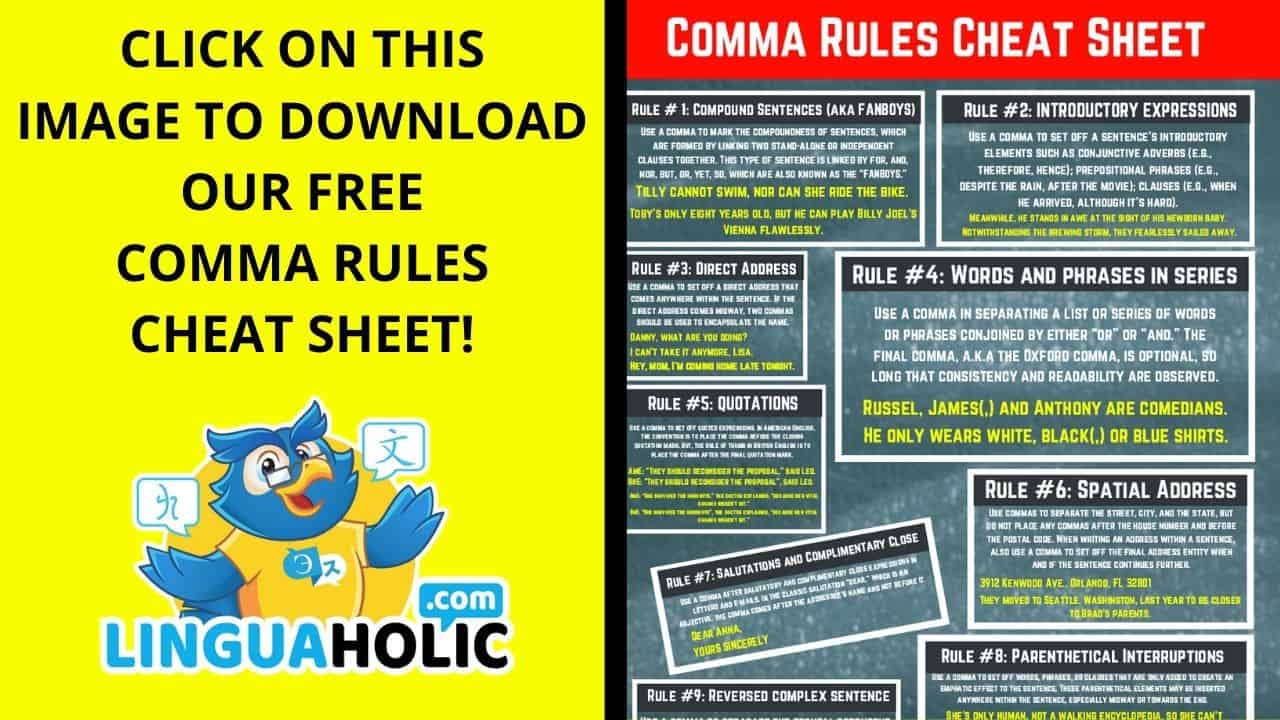
How analogous conjunctions work
Technically speaking, the word "and" is a coordinating conjunction, used to connect two parts of a sentence.
That is, "and" can be used to connect anything from a pair of private words to a phrase or loose group of words, to 2 consummate sentences.
Importantly for comma employ, analogous conjunctions are also used to connect two contained clauses or a dependent and contained clause.
Clauses are groups of words containing at to the lowest degree a bailiwick and a verb and, optionally, an object or other argument.
In plain English, a clause has to comprise an activeness word (the verb) and the person or thing doing the action (the bailiwick).
The optional part of the sentence is what'south existence afflicted past the action give-and-take (the object).
As for contained and dependent clauses, the difference has to do with whether each clause can stand lone.
If the clause makes sense past itself, it'south an contained clause. If you need the other clause in the judgement for it to make sense, yous're looking at a dependent clause.
When "and" is used as a coordinating conjunction, information technology simply means that both parts of the sentence it connects are understood to be joined to one another.
For case, a bar serving "beer and wine" ways that both are available.
Other examples of coordinating conjunctions are "only," "or" and "so."
To epitomize briefly before we await at commas earlier "and," coordinating conjunctions are just words that show the relationship between two parts of a sentence.
Using a comma earlier "and" when connecting two independent clauses
If you're feeling unsettled past all that grammar, accept heart!
The fact is, there's really only ane place where a comma is required earlier "and."
When is that? It'southward when you're using "and" to connect 2 independent clauses to one another.
Retrieve, independent clauses are clauses that stand alone. A good rule of thumb is that if you tin can split the clause off into its own judgement and still have it make sense, it'south an independent clause.
This rule too helps with when to apply a comma earlier "and."
If you have a sentence with "and" in it, but remove the word "and" and pretend the parts of the sentence on either side are their ain judgement.
Do both the new sentences make sense?
If they do, yous're dealing with 2 contained clauses and you definitely need a comma earlier "and."
Information technology's as simple equally that!
Examples
"I went to the ice foam shop, and I ate half dozen ice cream cones."
This is a clear case of ii independent clauses or two clauses that can stand up alone. To bear witness that, let'southward break them out into individual sentences:
"I went to the ice cream store. I ate half-dozen ice cream cones."
It's pretty obvious that both new sentences brand sense. That means we demand to put a comma before "and" in this example sentence.
"I watched a video on the news about a human being who ran into a cougar while jogging, and it was a terrifying video."
Past the same rule as before, the "and" in this judgement is connecting 2 independent clauses.
The second clause, "It was a terrifying video," is pretty short, simply that by itself doesn't mean information technology's a dependent clause.
Since this is still an independent clause, y'all need to insert a comma between it and the other, longer clause when you're joining them with "and."
In both these cases, the comma helps readers understand the sentence easily. Like all commas, information technology'southward there to add together clarity.
Joining dependent clauses: no comma required
An contained clause, described above, is a clause that stands lonely.
A dependent clause, on the other hand, is a clause that requires another, main clause in order to be understood.
Yous can use the same trick as above to identify dependent clauses. Just remove information technology from the sentence and see if it makes sense.
If information technology doesn't brand sense, it'southward a dependent clause and you shouldn't use a comma to join it to the primary clause.
Fortunately, y'all can only utilize "and" to join contained clauses.
That ways y'all don't need to worry almost dependent clauses when figuring out if you need a comma before "and."
Nevertheless, it's useful to know that for other analogous conjunctions, there are some cases when you lot shouldn't utilize a comma before them fifty-fifty when they're connecting two clauses.
Comma rules for other uses of "and"
Simply I digress. The bare minimum you lot need to know for using a comma before "and" is simply as described above.
What about other places when you can apply "and"?
The word is a simple one, but it has a lot of places it can appear in a sentence.
If the trick above doesn't satisfy you, read on to find out more about these other uses of "and."
The very short version, though, is that no other use of "and" admittedly requires a comma, and in almost all cases they're ungrammatical.
Do y'all need a comma when connecting 2 phrases with "and"?
Unlike a clause, which stands solitary as a grammatical unit, a phrase is a grouping of words that doesn't include a subject and a verb.
"Caput of cabbage?" That's a phrase. "Twelve royal turkeys" is also a phrase.
If you want to get technical, even "is besides a phrase" is also a phrase.
Meta!
Seriously, though, phrases are just groups of words that couldn't be turned into a sentence by themselves.
Practise you need a comma before "and" if information technology's connecting ii phrases?
You practice not. In fact, adding a comma will brand your sentence ungrammatical here, so don't do it!
Examples
"I'll have ice foam and a bowl of chocolate fries, delight."
Here, we take two phrases that are connected to form a pretty complex object for our verb "have."
The first phrase is "ice cream" and the second phrase is "a bowl of chocolate chips."
Both of these are joined past the word "and" to testify that the person speaking wants both.
At that place isn't a comma earlier "and" here because commas are only used when connecting contained clauses. Since these are phrases, don't utilise a comma.
"Let's play golf and go dancing."
Again, in that location are two phrases here. This time, nosotros have verb phrases, "play golf" and "go dancing."
Even though the phrases are different parts of spoken language than before, they're however phrases. That means nosotros tin't put a comma before "and" here, either.
"And" to connect two words
In improver to phrases, "and" can connect two single words.
This is arguably the simplest utilize of "and," and it's certainly the one with the fewest words involved.
But like with phrases, though, the comma rules are the same.
Don't employ a comma before "and" if it's non connecting two independent clauses.
It goes without saying that a single word tin can't be a clause, let alone an independent clause. That means if "and" connects two single words, y'all can't insert a comma in front of information technology.
Examples
"My favorite animals are llamas and sheep."
Llamas and sheep are both unmarried words in this sentence, so when nosotros utilise "and" to testify that the speaker likes both, we don't apply a comma to connect them.
If there were a comma, our brain would call up "and sheep" was the beginning of another judgement, which would be disorienting.
For example: "I like llamas, and sheep don't." Here, "and" is connecting two independent clauses, and the significant of our sentence is totally different.
When information technology comes to single words, we can't use a comma before "and."
Using "and" in a list
In some rare cases, "and" can be used to connect more than 2 items in a list or serial.
Technically, this isn't really a split use of "and." Later all, the items the word is connecting are going to be either phrases, unmarried words, or clauses.
Because it's actually just another use of "and" in disguise, it probably isn't a surprise that the comma rule is the same.
Unless all the items in the list are independent clauses, you should non put a comma earlier "and."
Examples
"Lions and tigers and bears, oh my!"
In this classic line from The Wizard of Oz motion-picture show, the discussion "and" is forming a list.
Although it'southward useful to know it's a list, that doesn't affect the comma rules.
None of our items in the list are independent clauses, so we tin't put a comma before any of them.
"I like lions, and I like tigers, and I similar bears also."
This might experience similar a bend brawl, since we've simply said you shouldn't put a comma before "and" in a list.
Simply let's look more closely at this example. All the items in the listing are really contained clauses.
To testify that, you tin split up them out into three carve up sentences: "I like lions. I like tigers. I like bears also."
Considering we're at present joining independent clauses together, nosotros do demand a comma before "and."
In short, the only thing we really need to consider is whether "and" is joining independent clauses.
If it is, you need a comma. Otherwise, you lot don't.
Are there any times when using a comma before "and" is optional?
So far, this is all cut and dry. (Notice how "and" connects ii single words there? No comma is used.)
Is it really that uncomplicated?
For the most role, yes, it is.
To exist true, though, there are really ii times when using a comma is an selection.
These two edge cases depend on what style guide you're using, and then be certain to check with a instructor or other authority if you're using them somewhere that matters, similar on a paper y'all want a adept grade on or if you're turning in an important report to your dominate at work.
A comma conflict: "and" and the serial or Oxford comma
One of the most brutal conflicts in all grammar has got to be the serial comma, also called the Oxford comma.
As we know, one place you can use "and" is equally part of a list.
In most style guides, that'southward all at that place is to it. You follow the normal rules and still don't put a comma before "and" unless it'due south joining ii contained clauses.
Notwithstanding, others argue that it'due south essential to include a serial or Oxford comma.
In manifestly English, all that means is that these people think you need a comma before "and" when it's in front of the last detail in a list.
Otherwise, they say, all chaos breaks loose, and it'southward impossible to tell the truthful meaning of a sentence.
There are some pretty good (and pretty funny) examples that testify the point, merely the truth is that it's almost always possible to tell what an author intended based on context or other clues.
For this reason, near style guides recommend that you don't employ a comma before "and" at the stop of a list unless it'southward otherwise impossible to understand the sentence properly.
The all-time affair to practise here is to read the sentence aloud.
Does it make sense? Is it clear what all the items in the list are?
If the reply is no, you lot might want to add a comma before "and."
Otherwise, unless your mode guide absolutely requires a serial or Oxford comma, don't add ane in.
Examples
"I'd like to thank my parents, Ayn Rand and God."
This is a classic example of why a comma tin can be useful before "and" in a series, and it'due south often cited as an argument for the importance the serial comma. It's probably apocryphal (that is, not a real thing anyone wrote), but it sure is funny.
What is the writer proverb here? Is he saying that his parents are the famous philosopher and author Ayn Rand and God, the all-powerful deity of Christianity?
Or is the writer actually saying "thanks" three times? In that case, nosotros might dissever this judgement up as: "I'd like to thank my parents. I'd like to give thanks Ayn Rand. I'd like to thank God."
It'due south pretty obvious that nobody in existent life is going to call up the writer is literally God's child, which is what makes this example and then funny, but what if, instead, we had fewer clues to go on?
"I'd like to thank Mary, my mentor and my married woman."
Is Mary the writer's mentor and the author'due south wife in this judgement? Or are these three different people?
Information technology's completely impossible to tell without more than context, so this is one time where you lot might want to apply that serial comma to aid in clarity.
"I'd like to give thanks Mary, my mentor, and my wife."
Although this sentence is a piffling ambiguous still (Is the phrase "my mentor" describing Mary, or are those 2 dissimilar people?) it's definitely an improvement.
In other cases, though, things are immediately clear without a comma.
"I similar h2o skiing, hiking and dancing."
Nobody is going to think hiking and dancing are somehow the aforementioned affair in this sentence. That means y'all don't actually need the serial comma.
The lesser line is that unless your manner guide requires a serial comma, or unless a sentence is completely unclear without information technology, y'all should skip the comma before "and."
Very short sentences and "and"
The other case where comma aren't completely necessary is when you accept two very brusk independent clauses being joined by "and."
Although you might technically need one based on the dominion we've described earlier, it all goes back to clarity.
In a short plenty sentence, information technology's really obvious what the significant of the clauses is and how they relate, so y'all don't really demand the comma.
Again, though, in formal settings it's best to just put in the comma before "and" anyway.
Examples
"I like llamas and sheep don't."
Remember this example from before?
The two independent clauses are "I similar llamas" and "sheep don't."
Technically a comma should be used to join them ("I like llamas, and sheep don't."), only it's really obvious what this judgement means without the comma so it's safe to go out it out.
Conclusion: the one simple dominion for commas before "and"
This article has hit on a lot of points and used a lot of examples, so you might feel your head spinning.
Let's finish up by reiterating the but rule you need to remember for comma utilize with the give-and-take "and."
That dominion is this: If "and" connects two contained clauses, apply a comma earlier "and." Otherwise, don't.
That's all there is to it!

Hey swain Linguaholics! It'due south me, Marcel. I am the proud owner of linguaholic.com. Languages have ever been my passion and I have studied Linguistics, Computational Linguistics and Sinology at the Academy of Zurich. It is my utmost pleasure to share with all of you guys what I know about languages and linguistics in general.
Source: https://linguaholic.com/linguablog/comma-before-and/
0 Response to "How Do You Know When to Have a Comma Before and"
Post a Comment